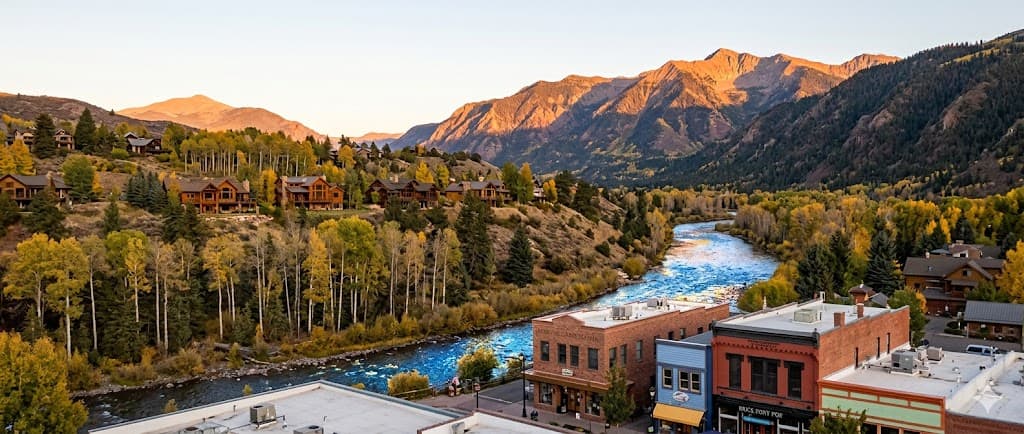
01A railroad junction that chose the rivers
Basalt began as a railroad town — Aspen Junction, where the Colorado Midland's line up the Fryingpan met the route to the silver boom — and took its permanent name in 1895 from the dark volcanic rock of the mountain above, incorporating in 1901. When the railroads faded, the town's geography revealed its second act: Basalt sits at the only confluence in the valley where two celebrated rivers meet in a walkable downtown, and it holds the exact midpoint of the corridor — far enough down for real life, far enough up for short mornings. That double inheritance — junction bones, river heart — explains the modern town precisely. Old Town's restored railroad-era blocks now front a riverfront park with a summer band shell; the fly shops on Midland Avenue serve water famous enough to draw anglers from other continents; and the mid-valley position that once routed trains now routes the valley's daily life through Willits. For a seller, the history distills to this: Basalt has always been the valley's connector, and its buyers are people who understood the map before they ever called an agent. Sell to that intelligence. It's the town's oldest tradition.
02Mid-valley: the position that prices everything
Basalt's defining economic fact is its position, and every sale here is finally a referendum on what that position is worth. The town sits at the Roaring Fork's midpoint: up-valley jobs and culture within a manageable morning, down-valley affordability visible in the rearview, both rivers running through the middle of the equation. That position attracts a particular household — the up-valley professional who refuses the up-valley housing math, the family that wants real schools and real streets inside a mountain economy, the remote worker splitting the difference between airport and wilderness — and those households have made mid-valley the corridor's most consistently demanded segment. For sellers this cuts two ways. Demand is structural: as long as up-valley employs more people than it houses, the mid-valley receives the overflow, in every season and every cycle. But the demand is also precise: mid-valley buyers know to a fine grain what the position commands, because they calculated it themselves on the way in. The seller's opportunity is to meet that precision with a prepared, exactly priced listing — and collect the position's full value from the buyers who came here specifically to pay it.
03The town's markets, read from the confluence outward
Start at the meeting of the rivers and work outward. Old Town is the scarcity market — a small grid of railroad-era buildings and homes that almost never trade, where the riverfront park has only deepened demand; listings here are events, and pricing to the waiting audience matters more than any calendar. Across the footbridge, Elk Run holds the walk-to-town middle: established homes on quiet loops with their own permanent waiting pool. South of the river, Southside runs on the school calendar — the family market, decided by preparation quality and launch timing. Down the highway, Willits is the new-build town center: contemporary homes and flats around the grocery anchor and the arts venue, comping against their own kind, rewarded for condition parity and walkability storytelling. West, Emma keeps the agricultural memory — farmsteads and acreage on the old rail grade, selling land-and-light to buyers the town market never sees. And up the canyon, the Fryingpan corridor is its own address entirely: river property on storied water, marketed to anglers with an angler's precision. Six positions around one confluence — and six pricing conversations that should never borrow from each other.
04Two counties, one town, zero room for assumptions
Basalt's least visible complication is administrative: the town spans the Eagle-Pitkin county line, with the larger share of parcels on the Eagle side and portions of the historic core in Pitkin. Daily life ignores the line completely — one downtown, one school district, one community — but a sale cannot. County determines where your deed records, which assessor values your property, how tax prorations calculate at settlement, and which county's processes govern the paperwork timeline. None of this is difficult; all of it is consequential when assumed instead of verified, because the mid-contract discovery that the county was wrong reads to a buyer like a sale being run carelessly — and careless is the one impression a precision market never forgives. So the parcel gets verified first, before the listing says a word: county, taxing entities, recording venue, all confirmed against the record. It takes an afternoon. It prevents the only category of surprise that a well-run Basalt sale should ever produce: none.
05The rivers as asset class
Basalt's rivers are not scenery — they are the town's most durable asset class, and a seller should understand exactly what they hold. The Fryingpan below Ruedi Reservoir is Gold Medal water, a tailwater fishery with a national name, and property along its corridor carries a premium paid by buyers who arrive already knowing the river's reputation. The Roaring Fork through town adds the broader version: riverfront and river-access properties that trade on sound, light, and the daily luxury of water at the end of the street. Selling river-adjacent property well demands an angler's precision in the language — frontage, easement access, and proximity are three different assets at three different values, and misstating them to a fishing-literate buyer costs credibility at the exact moment it matters most. It also rewards seasonal intelligence: river property photographed at summer flow or in October canyon gold outsells identical winter presentation. And even for homes nowhere near the banks, the rivers anchor the town's identity — the fly shops, the riverfront park, the anglers at the coffee counter — and a listing fluent in that identity is selling Basalt whole.
06Commissions in a two-ecosystem market
Basalt listings live between two brokerage worlds — the up-valley offices whose clients look down the highway when the up-valley math fails, and the down-valley community whose buyers climb toward the mid-point — and your commission structure should be built with both in view. Since the industry's 2024 changes, every term is decided by you at the endorsement of the listing agreement, which makes this a design conversation, not a custom to inherit. Cooperative compensation reaches the two ecosystems differently: up-valley brokerages steer well-advised clients for whom mid-valley is a considered move, and a structure legible to those agents measurably widens your pool; the commuter and family channels run on local representation with its own expectations. Your listing side should fund the work this particular market demands — pricing precision against the mid-valley's calculating buyers, two-county paperwork verified before launch, presentation that works for a remote up-valley first showing, and financing fluency across everything from stretched local offers to river-property complexity. Every line justified against this town's actual mechanics, in writing, before you endorse any of it.
07Selling to the calculated buyer
The through-line of every Basalt sale is the buyer's deliberateness, and the best marketing here simply honors it. These are households that chose mid-valley with a spreadsheet open — commute minutes, school ratings, river access, price per square foot against three other towns — and their touring behavior matches: fewer visits, sharper questions, faster decisions when the answers hold. A listing built for them answers in their language. State the position facts plainly: highway junction minutes, bus access, school assignments verified at parcel level. Present the working rooms as they are — the office, the mudroom, the garage that swallows the gear a valley life generates. Publish the documentation early: inspection, systems service, HOA papers where they apply, so diligence confirms rather than discovers. And price inside the town's own evidence, because this buyer has already read it. What you get in return is the calculated buyer's signature virtue: when they move, they move completely — strong terms, clean timelines, and a settlement that arrives exactly as scheduled. Precision in, precision out. That's the mid-valley trade.
08Both licenses, one confluence
Basalt sellers are almost always executing a sequence — the townhome funding the Southside house, the canyon cabin releasing its equity to a life back home, the Willits flat stepping up to Elk Run, the Emma acreage passing to its next steward. My practice runs the sequence whole. The broker's side carries the sale: parcel and county verified, position priced from Basalt's own record, marketing built for whichever of the town's six markets your property occupies. The mortgage side carries the money: your next purchase underwritten before the thin market tests you, the bridge structured before the calendars can threaten anything, and the buyer's financing on your sale read early with a lender's eye — because I am one — so the offer you accept is the offer that settles. One accountable person from the first worksheet to your keys in hand at the next address, wherever in Colorado that is. I serve the state from my base in Edwards, one pass over from this valley, and mid-valley moves are a standing part of my week. The consult is free. Bring your spreadsheet — I like the calculated ones best.