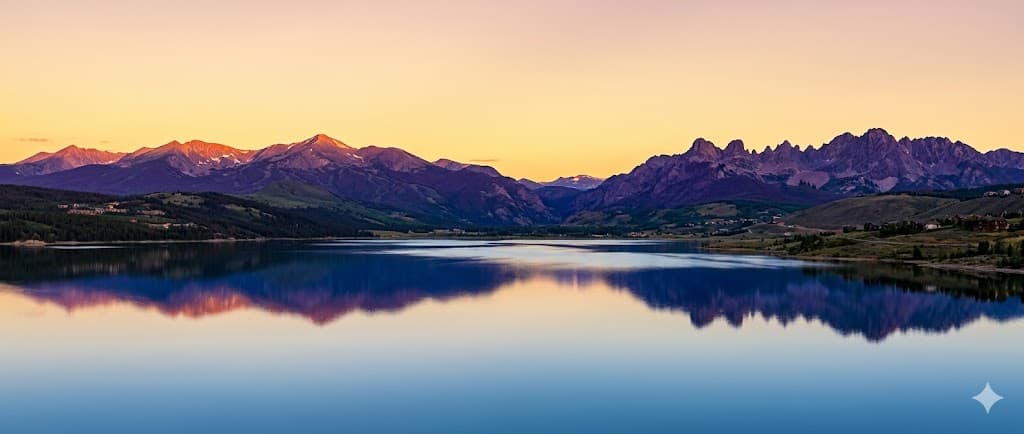
01One county, four mountains, and a lake that used to be a town
Summit County's geography reads like an inventory of Colorado's whole mountain story. Mining built it — gold in the river gravels from 1859, silver camps up every gulch, dredge boats working the valleys within living memory. Water remade it: Denver's thirst put a dam on the Blue River in the early 1960s, and the town of Dillon — which had already moved twice for railroads — moved a third time, uphill, so the reservoir could cover its old streets; the lake that resulted is now the county's blue centerpiece, with marinas, an amphitheater, and sailing regattas at altitude. The interstate finished the transformation: the Eisenhower Tunnel opened in 1973 and put the whole county within a morning's drive of Denver, and four ski areas — each with its own character, spread across three distinct ownership groups — grew into the demand that road delivered. That's the county a seller operates in today: a compact geography holding a real civic life, a massive resort economy, and a buyer who can tour all of it in a weekend. Selling well here means knowing exactly where your property sits in that inventory — because the buyer comparing across the whole county certainly will.
02The towns are the neighborhoods
On a county-level page it needs saying without decoration: Summit's neighborhoods are its towns, and they differ more than most cities' districts do. Frisco is the civic anchor — a genuine Main Street, the marina, the peninsula's recreation complex — and its housing sells the everyday-mountain-life proposition to full-timers and committed second-home owners alike. Dillon is the waterfront: condominium-forward, amphitheater summers, the county's best evenings. Silverthorne is the working engine — the youngest-feeling town, where workforce neighborhoods and newer development concentrate the county's year-round households. Keystone is the resort valley, condominium lodges on the Snake River, newly incorporated and still shaping what town-hood means for its owners. Copper Mountain is the pure resort village under county governance. And between the towns lie the unincorporated basins — Summit Cove, Dillon Valley, Wildernest, Mesa Cortina — where the county's workforce actually lives and where attainable listings meet permanent local demand. Breckenridge, the county's largest town, carries its own page and its own strategy. Each of these markets has its own buyer, rulebook, and rhythm — and a county listing that borrows another town's logic is mispriced before the photos are taken.
03A county where most homes are empty most nights
The defining fact of Summit County real estate needs no decimal places: a majority of the county's homes are not primary residences. The population can triple and more in the holiday weeks, then exhale; entire buildings breathe with the ski calendar. For sellers, this single fact reorganizes everything. Your buyer is probably not local — they're a Front Range household an hour away or an out-of-state family a full day of travel out, which makes digital presentation the real first showing and responsiveness across time zones a competitive weapon. Your comparable sales need careful reading, because a full-time neighborhood and a rental-heavy building can sit a mile apart and behave like different planets. Your own logistics are probably remote too — most sellers here manage the sale from somewhere else, which is a solved problem when the practice is built for it. And underneath it all, the county's constant tension — resort economy above, workforce reality below — means rules keep evolving, which is why verification beats assumption in every paragraph of a Summit listing. None of this is a warning. It's a description of the water every sale here swims in — and the sellers who do best are simply the ones who arrived equipped for that water.
04Several rulebooks, one parcel: getting jurisdiction right
Summit County operates as a patchwork of jurisdictions, and a seller's first diligence item is knowing which one owns their address. The incorporated towns write their own short-term-rental rules, their own licensing, and in some cases their own settlement-time costs. Unincorporated Summit — which includes Copper Mountain, the workforce basins, and plenty of homes with town names in their mailing addresses — answers to the county's system, which licenses rentals by type and caps them by neighborhood basin, with some basins full and waitlisted while resort-overlay zones run on different terms. The stakes of getting this wrong are not theoretical: rental capability that a listing implies but the rules deny, a buyer's business plan that dies in due diligence, a settlement surprise that renegotiates the price at the worst moment. The stakes of getting it right are quieter and better — a listing whose every claim survives verification, which sophisticated buyers and their agents notice fast. The homework takes a professional an afternoon: parcel records, current license status, the applicable rulebook, the building's standing. It's the least glamorous work in the sale and the hardest-working page in the file. We do it first, always.
05The questionnaire that decides your buyer pool
Every condominium sale in this county eventually meets the document I keep returning to: the questionnaire a buyer's lender sends the homeowners association. Its questions look bureaucratic — rental-pool arrangements, front-desk operations, insurance details, litigation, owner-occupancy — but its verdict is binary and enormous: either the big mortgage agencies will finance your building, or they won't. In a county whose base villages are thick with resort condominiums, that verdict quietly splits the entire market into two buyer pools. Buildings on the financeable side sell to the widest audience and should say so. Buildings on the other side — many of the best-located lodges in the county — sell to cash and portfolio-loan buyers, a narrower pool that must be targeted deliberately, with viable lending paths offered rather than hoped for. Sellers usually learn which side they're on when a contract collapses in underwriting, three weeks after celebrating the offer. My clients learn it before launch, because my practice fills these questionnaires out as a lender and reads them as a broker. Strategy built on the building's actual answer beats optimism built on its listing photos — every time, in every season.
06Selling to the weekend and the far away, at once
Summit's buyer pool arrives from two distances, and a strong listing works for both simultaneously. The near pool drives up from the Front Range — an hour when the tunnel cooperates — tours widely, and decides inside a weekend; it rewards launch timing that meets the Friday wave, showings that flex to a Saturday text, and documentation that lets a Sunday offer stand on facts. The far pool shops from Chicago, Texas, the coasts — often after seasons of visits — and buys the county remotely; it rewards presentation complete enough to purchase from, video and floor plans that answer the second visit's questions on the first scroll, and a transaction team fluent in electronic everything. The two pools share one trait: they are comparison shoppers across the whole county, fluent in what their money buys in each town and basin. Which is why the fundamentals — jurisdiction verified, financing profile known, price set inside the county-wide evidence — do more work here than any marketing flourish. The county's buyers are efficient. The winning listings are the ones that respect that efficiency and are simply, verifiably ready in both directions at once.
07Commissions across four markets wearing one county's name
The commission conversation in Summit County starts with a classification question: which of the county's several distinct markets is your property actually in? A Frisco Main Street home, a Keystone rental condominium, a Wildernest townhome, and a Copper village studio sell through different channels to different buyers — and fee structures that make sense for one can be decorative for another. Since the industry's 2024 changes, the terms all belong to you when you endorse the listing agreement, which makes the classification worth doing before the numbers are discussed. Cooperative compensation earns its keep where represented buyers visibly drive the segment — the Front Range weekender market runs heavily through Denver-metro agents comparing county-wide options for their clients. It earns less where buyers arrive direct through resort gravity or destination search. The listing side should fund what your segment demonstrably requires: the jurisdiction and financing homework, presentation complete enough to carry a remote purchase, and negotiation calibrated to whichever pool your property draws. The structure I put on that table is simple: every fee tied to identifiable work for your specific segment, in writing, before you endorse anything.
08The county file, held whole
A Summit County sale is rarely a single event — it's a move with parts. The Cove condo funds the Frisco house; the Keystone unit's proceeds head home to Texas; the longtime local finally trades altitude for knees and needs the next purchase standing ready. My practice holds the whole file: the broker's half runs the sale — jurisdiction verified, building profile known, launch timed to your property's season; the mortgage license runs the money — the next purchase underwritten while you decide, the bridge priced before anyone needs it, the specialty lending path ready for the buyer your building requires. I serve Colorado statewide from my base in Edwards — one county west, same mountains, same file. The consult is free, and it starts wherever you are: a phone call from Dallas works exactly as well as a coffee in Frisco.