01Potatoes for Aspen, and a town that kept its own name
Carbondale incorporated in 1888, named by settlers for Carbondale, Pennsylvania, and made its first living the least glamorous way possible: growing potatoes to feed Aspen's silver miners. That supply-town origin — this valley's farms feeding that valley's boom — set a pattern the town has never really broken: Carbondale serves the up-valley economy without belonging to it. The ranching heritage is still visible in the hay ground on Missouri Heights and celebrated every fall at Potato Day, a town gathering that has run for well over a century. What the town built on its ranching and farming foundation is its modern signature: a genuine arts community layered onto agricultural bones, with a certified creative district, a beloved community radio station, and a festival calendar anchored by Mountain Fair, running since the early 1970s. Mount Sopris rises over all of it — the fixed point every Main Street view eventually finds. For sellers, the history is the positioning: Carbondale has always been the valley's most self-possessed town, and buyers pay for self-possession. The listing that understands what this town actually is — working, creative, deliberately itself — is selling the asset at full strength.
02The mountain at the end of every street
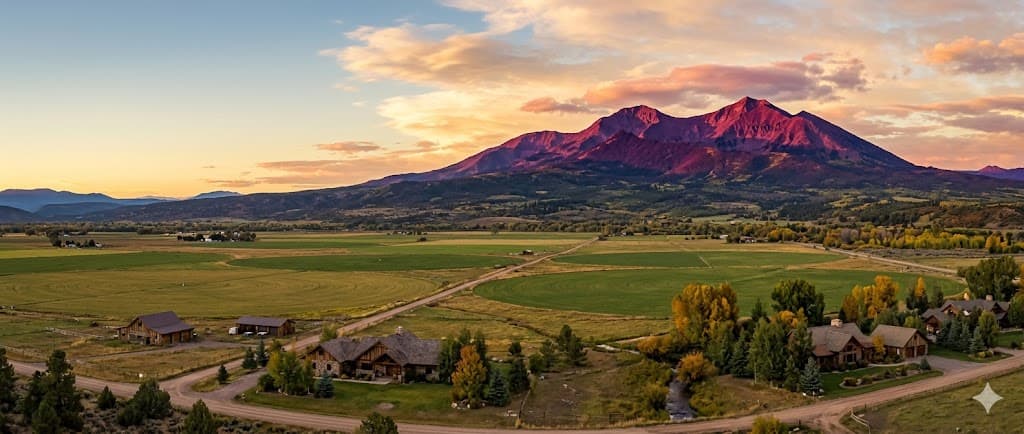
You cannot give a true account of Carbondale property without Mount Sopris, because the town is oriented to it the way coastal towns are oriented to the water. The twin-summited massif rises straight from the valley floor a few miles south, visible from Main Street, from the fairways at River Valley Ranch, from nearly every kitchen window with southern glass — and its presence is a measurable part of what buyers purchase here. Practically, that means view corridors are value corridors: the difference between a lot that frames Sopris and one that doesn't shows up in the comparables, and photography that captures the mountain faithfully — evening color, fresh snow on the shoulders — is not decoration but disclosure of an asset. It also means seasonal timing matters for presentation: the mountain sells hardest when it's white against June green. And it means something subtler about the buyer's psychology: people who choose Carbondale are usually choosing a daily relationship with that view, the trails under it, and the scale of life it anchors. A listing that treats Sopris as wallpaper undersells the second-most-valuable feature most Carbondale properties have.
03Reading the town's markets: cottage, fairway, mesa, gate
Carbondale is four or five markets sharing one zip code, and they reward being sold as what they are. The downtown grid and its cottages are the scarcity market — small supply, permanent demand, buyers who have waited years for two blocks off Main; preparation and disciplined pricing convert that waiting list into competition. River Valley Ranch is the family flagship: master-planned mountain homes around the public course, where condition parity and amenity fluency decide outcomes, and where the buyer is often trading up from in-town or arriving from out of the valley with kids and a bike rack. Satank is the connoisseur's pocket — historic, unincorporated, tiny — where listings are events and discretion sometimes outperforms exposure. Missouri Heights is the land market: acreage, water, horses, sky, and demanding land-sale competence. Aspen Glen is the club market, gated and distinct, comping only against itself. And the in-town family streets — Crystal Village and its neighbors — are the working heart, where the town's teachers, builders, and nurses compete for connected streets near the schools. Same town, five different buyers. The first strategic act of any Carbondale sale is knowing which of the five you're in.
04Water, land, and the paperwork that decides rural sales
A meaningful share of Carbondale-area property comes with land attached — mesa acreage, irrigated pasture, ditch shares, wells — and these sales succeed or fail on paperwork most town agents never touch. Water rights in this valley are real property with their own history and their own market: what a ditch-company share actually conveys, whether the well permit matches the use, which rights are senior enough to matter in a dry August — buyers' attorneys ask, and the listing that has already answered wins. County lines complicate quietly for some Missouri Heights parcels: verify which county a given property sits in, since that changes where documents record and how taxes prorate. Access, easements, and agricultural tax status each carry contract weight. And looming over all of it is financing: conventional lenders treat acreage, outbuildings, and agricultural use with a caution that kills contracts late, which is why rural sales here should be steered from day one toward lenders who reliably fund land — a judgment my practice makes from the lending side, with the buyer's file in hand. Rural Carbondale sells beautifully when the paperwork leads. It renegotiates painfully when it trails.
05Pricing a town that stopped being a discount
For years the shorthand priced Carbondale as Aspen's affordable shadow, and for years the shorthand has been increasingly wrong. The town's own desirability — the arts economy, the schools, Sopris, the intact Main Street — built demand that stands on its own, and the down-valley flow from Basalt and beyond keeps adding to it. Pricing here now requires holding two disciplines at once. Against the up-valley anchor: resist importing Aspen-orbit numbers onto properties whose buyers are valley households with real budgets; the inflated listing sits, publicly, in a town small enough that everyone notices. Against the discount reflex: resist pricing distinctive Carbondale property — downtown scarcity, mesa acreage, view corridors — as if the town were still a consolation prize; that reflex donates real equity to well-advised buyers who know better. The resolution is always the same: Carbondale's own record, read closely. What sold on those blocks, in that condition, to which buyer pool, how fast. I put that evidence in writing before we set a number, because in a self-possessed town, the defensible price is the confident one.
06Commissions here: paying for fluency, not just exposure
Carbondale's commission conversation turns on a word most fee discussions never use: fluency. This town's buyers — local families, up-valley arrivals, out-of-state deliberates — share one trait: they can tell instantly whether a listing understands the town. So when you set your terms at the endorsement of the listing agreement — and since 2024, every term, including any cooperative compensation, is yours to set — judge them against what they buy in credibility and reach. The listing side should fund the work Carbondale actually requires: a property classified correctly among the town's five markets, marketing written in the town's real voice, land-and-water competence where the property demands it, and financing fluency that keeps stretched local offers and complex rural contracts alive. Cooperative compensation earns its keep in the represented channels — the valley's working buyers lean on agents, and up-valley brokerages send serious clients down the highway — and earns less where your property's pool arrives direct. None of this is customary-percentage territory. It's a strategy document for a particular house in a particular town, and you should be able to interrogate every line of it.
07The festival calendar is a marketing calendar
Carbondale runs on a civic rhythm that a smart sale borrows. First Fridays fill Main Street monthly with locals and visitors in a browsing mood. The spring film festival brings a national audience into town for a weekend of exactly the demographic that buys here. Summer stacks the calendar — the rodeo runs weekly, the farmers market anchors Wednesdays, and Mountain Fair in late July floods Sopris Park with thousands who leave half in love with the town. Potato Day caps the season with the town's agricultural soul on full display. For sellers, this calendar is practical intelligence. A listing live during festival windows is toured by out-of-towners at peak susceptibility. Photography scheduled around the calendar catches the town at its most persuasive. Open houses timed to First Friday weekends inherit foot traffic no advertising budget could buy. And the listing copy itself should be fluent in the calendar, because your buyer is often someone who attended one of these events and never quite went home. We schedule launches with the town's rhythm in front of us, on purpose.
08One chair for the sale, the land, and the loan
Carbondale moves are rarely simple transactions: the estate with water shares, the family trading a cottage for the fairway, the mesa property whose buyer needs land-competent financing, the household stepping up within a market where almost nothing is ever for sale. My practice was built for exactly this tangle. As broker, I run the sale — classified correctly, priced to the town's own evidence, marketed in its real voice, with the land-and-paperwork discipline rural property demands. As mortgage broker, I keep the financing solid on both sides: your next purchase underwritten before you commit, the bridge structured before the calendars ask for it, and the buyer's loan on your sale steered toward lenders who will carry the property you're selling through to settlement. One accountable person, both licenses, from the folder of inherited paperwork to your keys in hand at whatever comes next. I serve Colorado statewide from my base in Edwards. The consult is free, and it works best if you bring everything — including the sticky note.