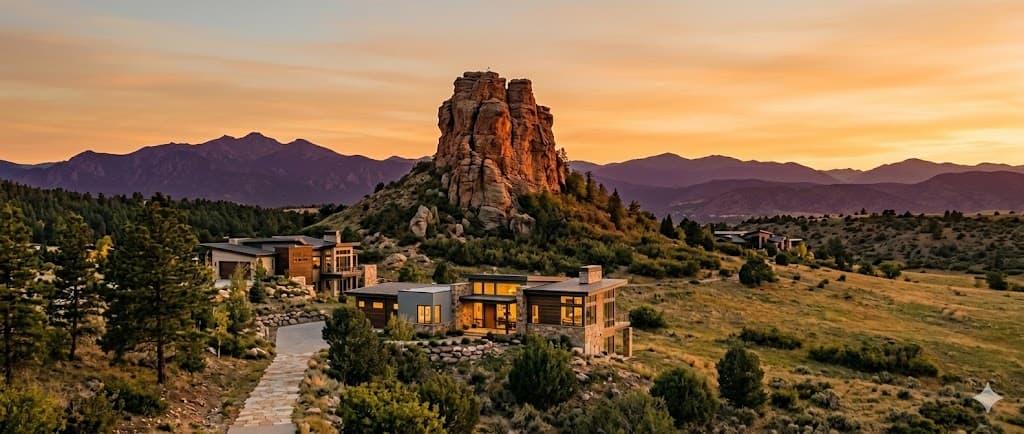
01The rock, the rhyolite, and the star
Castle Rock is named for the thing you can see from every corner of town — the castle-shaped butte that gave an 1874 settlement its identity and, for its first decades, its industry. The stone was rhyolite, quarried from the buttes and shipped up the rail line to build Denver's fine buildings, and you can still find it in the walls of the town's oldest blocks; Castle Rock was a stone town before it was a commuter town, county seat almost from the start, incorporated in 1881. The town's most beloved tradition sits on top of the namesake: the star on the rock, first lit in 1936, dark through the war years and relit in celebration in 1945, now lit every winter with a ceremony that has anchored the season for generations. None of this is nostalgia padding — it's market structure. In a corridor full of master-planned communities that could trade addresses without anyone noticing, Castle Rock has the things that cannot be built at a sales office: a butte, a downtown, a history, a star. The town's growth chose this place because it was a place. Sellers hold a share of that scarcity, and the strongest listings in town — from the historic pocket to the newest phase of The Meadows — all quietly sell it.
02The midpoint advantage
Castle Rock's geography is its economic engine: the town sits nearly midway between Denver and Colorado Springs on the interstate, which makes it one of the few Front Range communities drawing daily demand from two metropolitan job markets at once. The practical result shows up in every open house: a household commuting north to the Tech Center, another commuting south to a defense employer, a third working from home and choosing the town because it refuses to make them pick a city. Layered onto the two-direction pull is the county-seat reality — Douglas County's government, courts, and services concentrate here — and a school system whose reputation independently imports families from across the region. For sellers, the midpoint advantage translates into resilience and depth: when one metro's market cools, the other's demand keeps arriving, and the town's buyer pool stays fuller than its corridor competitors can manage. The marketing implication is simple and often missed: a Castle Rock listing should speak to both directions explicitly — access north, access south, and the home office that makes either optional. The town's whole position is optionality. The listing should sell the position.
03The neighborhoods, from the butte outward
Start at the center: the Craig and Gould blocks of the original townsite hold the historic pocket — early cottages under the butte, rhyolite in the old walls, Festival Park and Wilcox Street in walking distance; scarce, characterful, and priced on judgment rather than formula. Plum Creek wraps the public golf course just south, mixing patio homes and townhomes with single-family living — the low-maintenance segment with the shortest walk to a real downtown anywhere in the county. The Meadows commands the western hills as the town's largest master plan: schools, the hospital campus, trail networks, and a resale market with permanent demand and permanent new-construction competition — the neighborhood where the builder-comparison pricing work matters most. Founders Village holds the settled east: first-growth-wave streets now fully matured, the town's dependable family middle. Castlewood Ranch extends east toward the canyon with the big standard lots — elbow-room Castle Rock for households that wanted air between the houses. And Crystal Valley anchors the south, newer streets whose interstate access is improving in phases as the new interchange opens. Six segments, six different buyers — and every strong sale in town starts by naming which conversation it's actually in.
04Selling the finished home in a builder's town
Castle Rock's defining competitive condition is permanent, professional new-construction marketing — model homes staffed on weekends, incentive sheets refreshed monthly, and at the town's south end one of the region's largest master plans still building toward the thousands of homes it's approved for. Resale sellers who ignore this share the market with it anyway; the winners engage it deliberately. The engagement has three moves. First, price against reality: the builder's advertised base is not a comparable — the real all-in price includes the design center, the landscaping, the window coverings, and a year of waiting, and your pricing case should put those numbers side by side. Second, sell finished as the feature it is: grown trees, done basements, real streets with real neighbors, keys in four weeks — stated explicitly in the listing, because buyers standing in a model that morning need the contrast drawn for them. Third, hold a concession budget in reserve: builders negotiate with incentives, and a resale that can flex terms at the table — rather than pre-surrendering in price — matches that weapon precisely where it matters. The builders are not the enemy of Castle Rock resales. Unanswered, silent listings are.
05The school-map market
A large share of Castle Rock demand is school-driven in the most literal sense: families who selected the district before they selected the town, shopping with boundary maps open and enrollment calendars in mind. Selling into that demand rewards a specific discipline. Accuracy first — school assignments verified at the parcel level before the listing claims anything, because boundary assumptions are the fastest way to lose a researched buyer's trust, and this market's buyers are researched. Rhythm second — the family segments move on the academic calendar, with spring listings catching the summer-move planning wave; a family home launched in the wrong season isn't doomed, but it's swimming against the town's strongest current. Specificity third — name the assigned schools, state the walk-or-drive reality, and resist the adjectives; the school-driven buyer converts on verified facts and glazes over praise. And breadth last — remember that the same house also draws the two-direction commuters and the work-from-home arrivals, so the school story should headline without becoming the only story. The school map built much of this town. Selling with it, precisely, is simply selling with the grain.
06Pricing against two kinds of competition
Castle Rock pricing must answer two competitive fronts at once, which is one more than most towns ask. Against other resales, the discipline is standard and non-negotiable: recent neighborhood evidence, condition-adjusted, positioned to create first-two-week competition rather than a slow conversation with the market. Against new construction, the discipline is subtler: your comparable is not the builder's advertised base price — it's the fully-loaded cost of the equivalent finished home, which sits meaningfully higher and takes a year longer to become real. Sellers who anchor to the teaser base underprice their finished reality; sellers who ignore the builders entirely overprice into subsidized competition. The resolution is a two-front case, built in writing: where your home stands in the resale evidence, and what the finished-home premium is truly worth against the model down the road — with the builders' incentive calendar factored into launch timing. It's more work than one-front pricing. It's also why two otherwise identical Castle Rock sales can finish five figures apart — and why the number on your listing should be the product of both analyses, not a compromise between guesses.
07Commissions where the buyers bring agents and maps
Castle Rock's commission conversation is shaped by who its buyers are: represented, researched, and specific. The school-driven families arrive with agents and boundary maps; the two-direction commuters arrive with agents and spreadsheet tabs; even the builder-curious arrive with opinions formed at a sales office an hour earlier. Since the industry's 2024 changes, every term is decided by you at the endorsement of the listing agreement — and this market gives each term a concrete job. Cooperative compensation is a live decision here because represented buyers dominate the family segments: terms legible to the agents steering district-first clients keep your home on the tours that decide outcomes, while the same offer may matter less in segments where buyers arrive direct. The listing side should visibly fund the two-front work this town demands: pricing built against both resale evidence and builder true-cost math, parcel-verified school facts, launch timing read against the incentive calendar, and negotiation that can flex concessions against a sales office's sheet. Every line tied to a job, every job tied to this town's actual mechanics — in writing, before you endorse anything.
08One office for the sale and the next address
Almost every Castle Rock sale is the first half of a move — up to the quarter acre, out of state behind a promotion, into low-maintenance by the golf course, or the classic corridor trade toward one metro or the other. My practice is built to hold both halves. The broker's side runs the sale with this town's specific playbook: the finished-versus-model argument made explicitly, the two-front pricing done in writing, the school facts verified to the parcel, the launch timed against the builders' calendar. The mortgage license handles the financing: your next purchase underwritten before you shop — whether the destination is Castlewood Ranch or another state — the bridge structured before the calendars can squeeze you, and every incoming offer on your sale read with a lender's eye, so the buyer you pick is the buyer who settles. One office, both licenses, one person accountable from the first worksheet to your keys in hand at whatever address comes next. I serve Colorado statewide from my base in Edwards. The consult is free — and if a builder's incentive sheet is what's worrying you, bring it. We'll price the finished home against it, line by line.