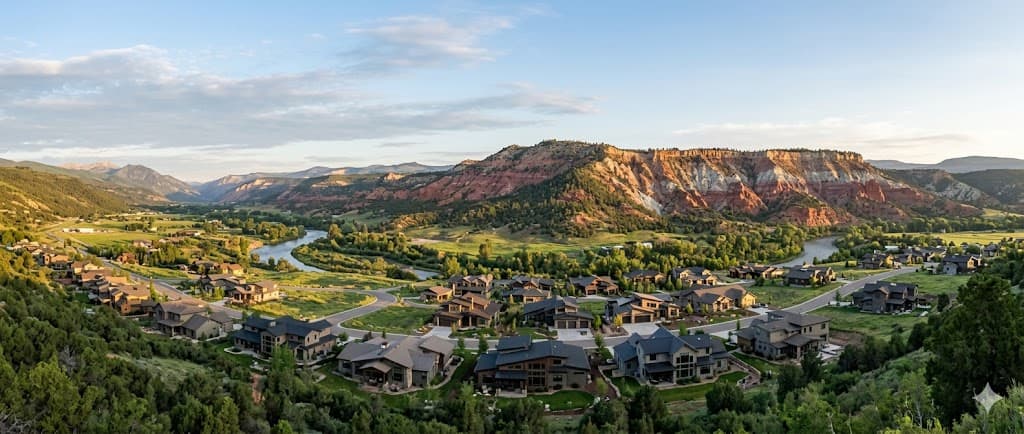
01The ranch town that became the valley's answer
Gypsum was settled in 1881 and incorporated in 1911, a ranching town named for the mineral in its hills, and for most of a century it stayed exactly that — the quiet agricultural west end of a valley that grew famous somewhere up the road. Two arrivals changed its trajectory. The wallboard plant that opened in the 1980s put the town's namesake mineral to work and gave Gypsum a genuine industrial anchor, one that still operates today with decades of reserves ahead of it. And the county airport at the town's edge grew from a regional strip into the valley's connection to the country — winter nonstops from coast to coast, year-round service, and an economic gravity all its own. But the deepest change was the valley's own hard math: as the resort towns priced out the people who run them, Gypsum became the straight answer to the question every mountain economy eventually faces — where does the workforce actually live? The answer built the neighborhoods this page describes, filled the schools, and made Gypsum one of the county's steadiest markets. This is not the valley's afterthought. It's the valley's foundation — and its housing demand behaves accordingly.
02Where the county's demand actually pools
Eagle County's housing math has one constant: the up-valley towns employ far more people than they house, and the difference has to live somewhere real. Gypsum, with Eagle beside it, is where that difference pools — the attainable end of the corridor, the place where a ski-company manager, a hospital nurse, and a heavy-equipment operator can all still buy a single-family home in the county where they work. For sellers, this produces the market's defining condition: structural demand that renews every hiring season. The buyer pool is not a trickle of the curious; it's the standing population of valley households watching for their chance, plus the airport-borne buyers who found the west valley from the sky. What the depth of demand does not do is excuse careless selling. Gypsum's buyers are budget-precise and increasingly well-advised, the town's own new construction competes for them, and the difference between a prepared launch and a casual one shows up directly in the final number. The demand is the town's gift to its sellers. The results still belong to the ones who prepare.
03The neighborhoods, from the creek to the mesa
Old Town holds the origins — modest early homes near the creek and the amphitheater grounds, long tenures, and the occasional estate sale that carries a family's whole valley history in its paperwork. Buckhorn Valley, on the bench by the airport, is first-house Gypsum: newer attainable homes where the town's young households concentrate, with demand as steady as the flight schedule. Chatfield Corners is the family engine — two-story homes on connected streets near the schools and the recreation center, running hard on the school calendar. Cotton Ranch arranges itself around the town-owned golf course, which plays the longest season in the high country and gives the neighborhood its unhurried character; its homes trade on fairway light without private-club pretense. Above it, Sky Legend is the custom tier — mesa lots, long views toward the Flat Tops, the town's calmest streets. And Stratton Flats, built as a deliberate answer to valley attainability, has matured into settled workforce blocks with the town's most reliable buyer line. Six neighborhoods, one continuous range — from a family's first townhome to a custom home on the mesa — and a seller's strategy should know precisely which rung of that ladder it's selling.
04Pricing with confidence at the attainable end
Gypsum pricing goes wrong mainly through timidity — sellers who reflexively discount because the town is the valley's affordable chapter, as if affordability meant apology. Read the market instead. Demand at this end of the valley is the county's deepest; inventory rarely satisfies it; and well-prepared homes here routinely draw multiple offers within days. The evidence-based price for a Gypsum home is set the same way it would be anywhere serious: recent sales in your specific neighborhood, condition-adjusted, read against current competition including the builders' true completed costs — and then positioned to convert the town's standing demand into first-week competition. Two local disciplines sharpen it. First, respect the ceiling-consciousness of workforce buyers: a price just inside the evidence invites their strongest offers, while a reach beyond it excludes the very pool the town runs on. Second, weigh the offers, not just the numbers — in a multiple-offer week, the highest figure with fragile financing loses to the solid one every time, and telling them apart is a lender's skill. Priced with confidence and read with discipline, a Gypsum sale is one of the most dependable transactions in the county.
05The airport effect, stated plainly
The county airport sits at Gypsum's edge, and its effect on the town's market deserves the plain treatment locals give it. The winter flight map connects the valley nonstop to cities across the country, which does three things for west-valley property: it delivers a stream of arriving visitors who discover that the valley has an attainable end; it anchors a growing base of aviation, service, and logistics jobs whose workers need homes nearby; and it gives Gypsum a connectivity argument no town its size should rightfully have. The fair counterweight is sound: some neighborhoods hear the approach path, buyers vary in how they weigh it, and a listing serves itself best by stating position factually and letting the buyer's own ears decide. What sellers should not do is treat the airport as anything but the economic asset it is — the runway is a standing reason households and employers choose this end of the valley, and west-valley property values have grown up alongside it. Precision, not promotion: that's the airport paragraph in every well-run Gypsum listing, and it converts the skeptical buyer more reliably than any soft-focus omission.
06Commissions where the offers come in stacks
Gypsum's commission conversation should be shaped by the town's signature condition: the prepared listing that draws several offers in its first week. Since the industry's 2024 changes, every term — your listing side and any cooperative compensation — is set by you when you endorse the listing agreement, and in this market each deserves a specific test. Cooperative compensation matters here because the valley's workforce buyers are overwhelmingly represented — often by agents coordinating tight budgets, employer programs, and up-valley schedules — and terms legible to those agents keep your listing on the tours that matter. Your listing side should fund the work a multiple-offer market actually requires, which is different from a slow market's work: preparation that makes the home competition-ready on day one, launch logistics tuned to the valley's commuter rhythms, and above all the offer-analysis discipline to sort strong financing from hopeful paper when the stack arrives — the judgment my lending license exists to provide. In a town where demand shows up in crowds, the fee's job is converting the crowd into the right contract. Structure it for that, in writing, before anything is endorsed.
07Selling a home the valley is waiting for
Preparation in Gypsum is a competitive act, because the standard is set by the town's own model homes and the stakes are set by its multiple-offer weeks. The mechanical file comes first: pre-listing inspection, systems serviced and documented, the small repairs done — workforce buyers stretch to buy here, and certainty is the amenity they prize most. Presentation meets the model-home standard next: clean, bright, staged to the way valley families actually live, photographed in the west end's generous light. The paperwork completes it: disclosures, utility history, and HOA documents where they apply, assembled before launch so a buyer's agent can write a same-week offer without a single open question. Then the launch itself gets engineered — live in the window when commuter buyers can actually tour, priced to invite the competition the demand guarantees, with showing access that flexes to shift schedules. A Gypsum home prepared to this standard doesn't just sell; it selects — from a stack of offers, on the seller's timeline, at the number the competition discovered. That's what the valley's deepest demand pays for. Preparation is how you collect it.
08The valley's move, handled by a neighbor
I live and work here in the valley, and Gypsum sales are neighborhood work for me in the literal sense — twenty minutes down the road, in the market where my own week happens. That proximity shapes the practice. As broker, I run your sale with the west end's specific mechanics in hand: the demand pool and its rhythms, the builder competition's true pricing, the launch windows that catch commuter buyers, the offer-stack discipline that picks the contract that settles. As mortgage broker, I run the money: your next purchase underwritten before you shop — in this valley, readiness is the whole game — the bridge structured in advance if your settlements need room, and every buyer letter on your sale read with the professional skepticism that protects your timeline. One person, both licenses, from the first complete worksheet to your keys in hand at the next address, whether that's Chatfield Corners, Eagle, or somewhere up the road I drive every day. The consult is free and it's local. Bring your questions — I'll bring the letter that starts everything.