Home Equity in Breckenridge — HELOC and Home Equity Loans From a Local Lender
Few markets in America build equity like this one — long-held locals' homes, second homes owned for decades, ski condos bought before the base areas grew up around them. Here's how to reach yours without selling it.

See Your Maximum HELOC
Slide to your home’s current value for an instant estimate.
Maximum HELOC Available
$750,000
Program maximum reached
Based on 85% CLTV · Program maximum: $750,000
Want your real number? Subtract your existing mortgage balance from this — or let our full calculator do it for you.
No credit impact · 60-second full estimate
Three Ways to Reach Your Equity
Your equity is the gap between what the property is worth and what you still owe on it — and in Breckenridge that gap is often the largest number in an owner's life. If your first mortgage predates the current market, the second-lien routes exist precisely so you don't have to touch it.
HELOC
Reusable, sized to your plan.
A credit line secured by the home
Available in fixed- and variable-rate forms, sized to your plan and reusable under many program structures.
Home Equity Loan
For a single known number.
A one-time lump sum
A one-time lump sum with a set payment — clean for a single known number.
Cash-Out Refinance
Usually the costly route.
Replaces your first mortgage
Replaces your entire first mortgage to extract cash — which usually means trading away a rate you'll never be offered again.
Equity Here Isn't One Market — It's Two
Market Snapshot
Breckenridge, CO
- County
- Summit County
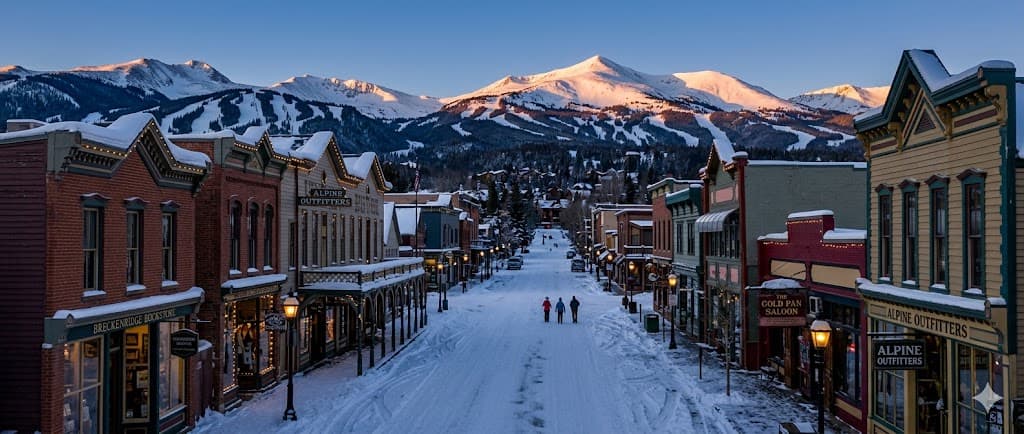
Breckenridge runs on two property economies at once. In-town and on the flanks sit the single-family homes — Victorians on the historic grid, Peak 7 and Warriors Mark houses where year-round families live, custom builds in the Highlands near the golf course. At the base areas sit the condos and townhomes — the resort-zone buildings that host the town's visitors. The two hold value differently, finance differently, and carry very different paperwork, and a lender who treats a Peak 9 base condo like a suburban ranch house will get the file wrong from the first page.
Two local wrinkles matter before you borrow. First, jurisdiction: plenty of homes with Breckenridge addresses — much of Peak 7, Blue River, the outlying corridors — sit outside town limits, and the rules change at that line, from rental licensing to the town's transfer tax. Second, that transfer tax quietly argues for borrowing over selling: every sale inside town limits triggers the town's transfer levy — formally the buyer's bill, but priced into every negotiation — while borrowing against the home triggers nothing at all.
Equity From a Second Home Here
This is a majority-second-home market, and a second-home file is read on stricter terms — thinner ceiling, thicker credit, more paper — and it lands on fewer desks, which is why it gets placed, not blasted. Condo owners add one more layer: underwriters read the building's HOA and master insurance policy alongside your finances, and in Summit County those policies have become a story of their own. None of this is a wall. It's a map — and one more local fact runs in your favor: rental licenses here don't follow a sale, so an owner who borrows keeps everything exactly as it stands, while an owner who sells hands the next buyer a fresh application — and in much of town, a waitlist.

I've watched Breckenridge owners sit on decades of appreciation because touching it felt complicated — the condo, the second-home paperwork, the building's insurance file. It's not complicated. It's specific. So here's my question: if that same equity were sitting in an account with your name on it instead of frozen in the framing, what would you already be doing with it?
— Bobby Friel, NMLS# 332039
How It Works With One Local Lender
The Conversation
Ten minutes on your situation and the property. Primary, second home, or investment — say it plainly; the right program depends on it.
The Valuation
What the property is worth now, and what's reachable against it for its occupancy type.
The Placement
One application, soft pull through prequalification (the single hard pull waits for the full application), matched across a lender network to the program that wants your exact file — fixed or variable, line or lump sum.
Funded
Clean files move in as few as 5 days. Second-home files skip the built-in federal pause that primary residences get, so for them, signing and funding sit even closer together.
The Mistakes Breckenridge Owners Make
Mistake 01
Calling the number on a national ad.
A call-center lender prices a Breckenridge condo like a city apartment — then discovers resort zoning, the HOA’s master policy, and short-term-rental history at underwriting, and the file dies at week six. Start with someone who knew what a base-area building was before you said it.
Mistake 02
Bringing primary-residence paperwork to a second-home file.
Occupancy classification drives everything — the cap, the credit floor, the reserves, the documentation. Owners who assume their second home borrows like their first home lose weeks re-papering. Named correctly on day one, it’s just a different checklist.
Mistake 03
Treating insurance as a formality.
Every equity loan requires hazard coverage, and in high-country Colorado that’s a real conversation — wildfire scoring on single-family homes, master-policy costs inside condo buildings. Get the insurance answer before underwriting asks the question, not after.
Your Breckenridge Equity Questions, Answered
The Mountain Did the Appreciating. The Next Move Is Yours.
One conversation. Your number, your options, no obligation — and your first mortgage stays exactly where you left it.