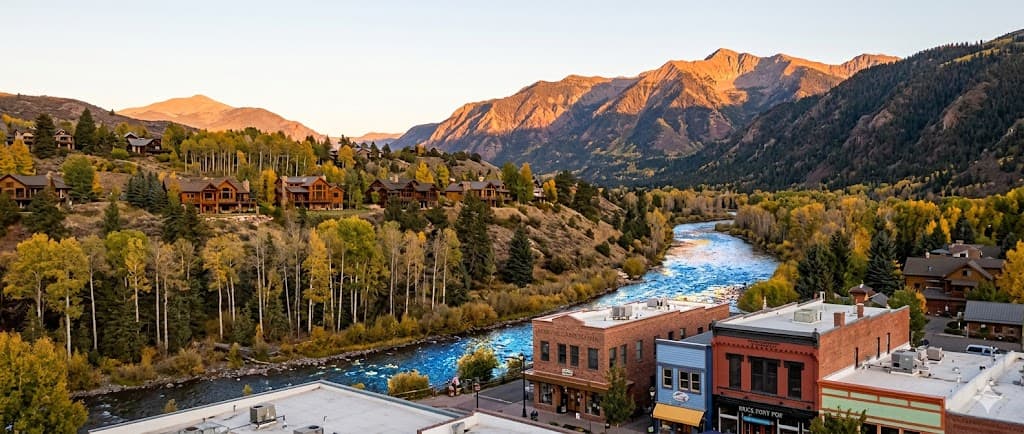
Home Equity in Basalt — HELOC and Home Equity Loans From a Local Lender
The midvalley's town sits where the Fryingpan runs into the Roaring Fork, halfway between Aspen and Glenwood Springs on the highway, with a Victorian main street, a new town at Willits, ranch country up the Fryingpan, and a deed recorded in one of two counties. The equity runs through every part of it, and the first thing I ask about a Basalt house is one most lenders never think to.

See Your Maximum HELOC
Slide to your home’s current value for an instant estimate.
Maximum HELOC Available
$750,000
Program maximum reached
Based on 85% CLTV · Program maximum: $750,000
Want your real number? Subtract your existing mortgage balance from this — or let our full calculator do it for you.
No credit impact · 60-second full estimate
Three Ways to Reach Your Equity
Basalt owners know what a regulated river looks like. The line releases as the season calls for it. The loan releases once — a known volume on a known schedule. The refinance drains the reservoir and refills it under new terms.
HELOC
Released as the water's needed
Steady flow, your gauge
A revolving or program-structured line, fixed or variable, junior to the first mortgage in place — drawn for the phase in front of you, in the form your program provides, without a new first mortgage anywhere in the picture.
Home Equity Loan
Released once, a known volume
One sum, on a schedule set in advance
For an expense that already carries a figure — a remodel bid, a lot purchase, a settlement — paid out in full and amortized over a term fitted to that purpose, beside the mortgage it never disturbs.
Cash-Out Refinance
Drains and refills
A new reservoir behind a new first mortgage
It reaches equity by retiring the first mortgage and writing a replacement at today's terms. Worth it when the old loan needed replacing on its own merits; costly when it didn't — and in this valley it usually didn't.
Where the Fryingpan Meets the Fork
Market Snapshot
Basalt, CO
- County
- Eagle & Pitkin County
Basalt began as two camps: a charcoal-kiln settlement called Frying Pan Junction in 1882 and a railroad camp called Aspen Junction when the Colorado Midland arrived in 1887. The post office renamed it Basalt in 1895 — too much mail was going to Grand Junction — and the town incorporated in 1901, named for the dark rock of the mountain above it. It grew into the commuter and commercial hub between Aspen and Glenwood Springs, with the rapid bus running Highway 82 through it, the Rio Grande Trail on the old railroad grade, Gold Medal water on the Fryingpan below Ruedi, and a grocery-anchored new town at Willits that gave the valley a second downtown.
The housing follows the geography. Old Town is Victorian-era Midland Avenue and Two Rivers Road at the confluence — small lots, older wood-frame houses, later infill, the whitewater park at the end of the street. Southside holds single-family homes and duplexes below the high school; Elk Run is the big subdivision on the hill. Willits is the new town — lofts, row homes, townhomes, and single-family on a walkable grid around the market and the arts campus, with association covenants on most of it and a metropolitan district under much of that side of town. Up the Fryingpan and out at Emma, the town gives way to ranch country and riverfront parcels on county rules. And one fact runs through every one of those neighborhoods: Basalt is a single town in two counties, Eagle and Pitkin, and a parcel's assessor, treasurer, and recording office follow the county line rather than the town limits. Which county holds your deed is the first thing I confirm on a Basalt file — ahead of any valuation or title order.
A Town That Built a Lot of Its Own Restrictions
Basalt carries a large share of its housing under deed restrictions — some the Town required of developers, some it built with partners, from the price-capped homes behind the high school to for-sale units at Willits and Southside, with employee rentals folded into projects as far as the private club on the river. For an owner of a price-capped home, the restriction sets the resale number, and that number, not the open market's, is the one any lender starts from; its holder usually has to acknowledge a new lien, so I ask for the covenant and the holder's contact on the first call. For the unrestricted majority, the file reads the neighborhood instead. Whole-ownership cabins at the club and riverfront homes up the Fryingpan often run as second homes, with the tighter rules those bring; fractional club interests generally find no lender at all. And every file here reads the mountain: the fire that started at the shooting range in the summer of 2018 burned Basalt Mountain above town, took a handful of homes at the edge of El Jebel and Missouri Heights, and left a scar that sent mud across Fryingpan Road the following year. Wildfire scoring here is done parcel by parcel, and the drainages that ran with mud carry a flood history now. A policy that already accounts for that is the second document I want, right behind the deed.

Basalt is the one town I work where the deed can say Eagle or Pitkin and the owner's story doesn't change either way: I bought here for the river, the schools, and a commute I could live with, and the house has grown into the biggest thing I own. So here's my question: what's the one project that would make staying here better — and what's it actually waiting on?
— Bobby Friel, NMLS# 332039
How It Works With One Local Lender
The deed's recording stamp
Eagle or Pitkin decides the assessor, the treasurer, the title company's search, and the office where the new lien is filed. It gets settled before anything is ordered, and it takes one look at the deed.
Comps from your stretch of the river
Willits sells to one buyer, Midland Avenue to another, a Fryingpan parcel to a third; the valuation is drawn from the stretch you own.
Released through one application
A restricted home opens with its covenant's terms; an unrestricted home goes straight to placement. Either way: one application, a soft pull through prequalification, and a single hard pull at the full application itself — variable or fixed, revolving or lump-sum.
Wired in days
Clean files fund in as few as 5 days: county confirmed, restriction terms in hand, coverage bound.
The Mistakes Basalt Owners Make
Mistake 01
Ordering title in the wrong county
A Basalt address doesn't say which county holds the deed. Order the title work or the tax certificate from the wrong county and the file restarts before anyone has looked at the house. The recording stamp on your deed names the county; that page comes first.
Mistake 02
Expecting the burn scar to be forgotten
The slopes that burned above town and the drainages that ran with mud afterward are underwriting facts now, and a policy that hasn't been re-quoted since then may be priced for a different Basalt. The current policy, and what the roof and the defensible space look like today, go into the file with the deed.
Mistake 03
The holder's signature is a starting document
On a price-capped home the restriction's holder has a say in what records against it, and its paperwork runs on its own calendar, not the lender's. Send me the covenant and the holder's contact with the application and that calendar starts on day one.
Your Basalt Equity Questions, Answered
Ask Where the Rivers Meet.
Talk to someone who works both ends of the valley — your stretch of the river, your number, no cost to ask, and the mortgage on the house left as it is.