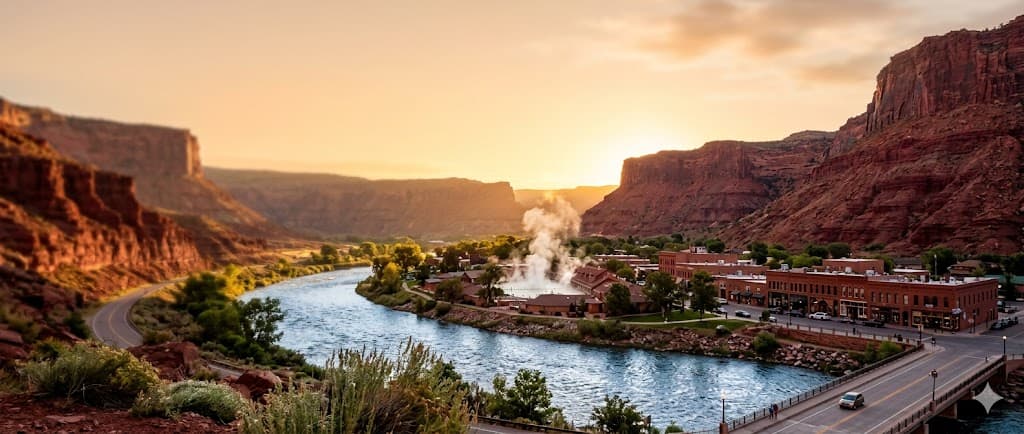
Home Equity in Glenwood Springs — HELOC and Home Equity Loans From a Local Lender
The town at the mouth of the canyon — hospital, college, courthouse, and the hot springs that started it all — is the one this whole region depends on, and the people who keep it running live here all year. Their houses have come through two fires and a canyon that closes, and the equity in them is considerable. This is how a Glenwood file gets built.

See Your Maximum HELOC
Slide to your home’s current value for an instant estimate.
Maximum HELOC Available
$637,500
Based on 85% CLTV · Program maximum: $750,000
Want your real number? Subtract your existing mortgage balance from this — or let our full calculator do it for you.
No credit impact · 60-second full estimate
Three Ways to Reach Your Equity
Watch what the monthly payment does; it tells the three apart. On a line, the payment is figured on what you've actually drawn, and figured again whenever you draw more. On a loan, it's figured once and stays there. On a refinance, it's your entire mortgage payment, worked out again from the first dollar.
HELOC
A payment that follows the balance
Figured on what you've drawn
A fixed- or variable-rate credit line recorded after the mortgage in place — used for work that arrives in pieces, under the draw terms your program sets, with a payment that reflects only what's outstanding.
Home Equity Loan
A payment that doesn't move
Level from month one to the last
For an expense with one figure — a roof, a buy-in, one contractor's invoice — funded in full and paid on a schedule known today, with the mortgage left out of it.
Cash-Out Refinance
Your entire payment, worked out again
Every month of the old loan, re-signed
The equity comes out only when the first mortgage is paid off entirely, so the payment you've had for years is thrown out and a new one, priced the way the market prices a mortgage now, takes its place. Sound if that old loan had earned its retirement. Costly when the old loan was the one you'd have kept.
From Defiance to the Hub of Two Valleys
Market Snapshot
Glenwood Springs, CO
- County
- Garfield County
The settlers called it Defiance until the founding family renamed it for Glenwood, Iowa, in 1883. The county seat followed within months, incorporation in 1885, the railroad through the canyon in 1887, and the year after that a silver baron who had walled the Colorado River into a new channel opened the biggest hot-springs pool anyone had seen. The grand hotel went up in 1893; a president summered there; a famous gunfighter died here, and the cemetery above town carries his marker. The interstate through the canyon wasn't finished until 1992 — the last piece of I-70 in the country — and when it closes, for a fire or a mudslide, the whole region feels it. In the meantime Glenwood turned into the hub of two valleys: the hospital, the college's headquarters, the county government, the train that still stops at the 1904 depot, and the retail that draws people from Rifle to Aspen.
That makes it a year-round, workforce town — a place with a lot of renters and a lot of long-held houses, where owners commute upvalley on the bus or stay and run the town. Downtown is the Grand Avenue grid: Victorians and early-1900s houses, small condos, apartments over storefronts. Glenwood Park is the mid-century neighborhood of ranches and remodels; Park East sits toward the canyon mouth; Red Mountain climbs the hillside above. West Glenwood is the service side along the old highway — single-family, duplexes, the big-box stores, the Mitchell Creek drainage. South of town the highway corridor runs past the schools toward Cardiff Glen, named for a coke-oven town whose brick ovens still stand beside the airfield, and up Four Mile Road toward Oak Meadows and the ski hill. And outside the city, with Glenwood addresses: Ironbridge, the master-planned golf subdivision on the Roaring Fork with a block of county-restricted homes among the market ones; Westbank's river and bench lots; Spring Valley's acreage by the college; No Name, tucked into the canyon's mouth.
What Burns, What Floods, and What's Recorded
A Glenwood file reads hazards the way a Front Range file reads hail. Storm King, just west of town, burned in 1994 and is a memorial now. The fire of 2002 is traced to a coal seam that had been burning underground since 1910; it ran into West Glenwood, Mitchell Creek, Four Mile, and Red Mountain, taking homes with it, and the coal under the ground west of town has burned for more than a century. The canyon fire of 2020 closed the interstate for two weeks, and the debris flows off its burn scar closed it again the next summer. The city's own geologic-hazard ordinance requires rockfall mitigation where the maps call for it, and the city's own flood planning names Three Mile Creek, Mitchell Creek, and the confluence as its trouble spots. Each of those is priced by a carrier and read by an underwriter, and a house with the right policy and the right permits lends like any other. Then the recorded layer: the county's housing authority runs three kinds of deed restriction in this county — income-qualified with a capped resale price, employment-qualified with a cap, and employment-qualified with no cap at all — and the city's own down-payment loan records as a second lien with its own rules about what may be placed behind or ahead of it. A regional buy-down program puts price-capped restrictions on ordinary-looking houses. The record is where the file opens.

Glenwood has always been the practical town — the one two valleys drive to when something has to get done — and the people who keep it open own houses that have carried equity through every fire and every closure. What is your equity supposed to be doing right now, and when did you last make it justify itself?
— Bobby Friel, NMLS# 332039
How It Works With One Local Lender
What's already recorded
A city second, a housing-authority restriction, or a clear title — the record says which file this is, and it's pulled ahead of any valuation.
Comps from your ring of town
A Grand Avenue Victorian, a Glenwood Park ranch, an Ironbridge fairway home, and a Four Mile bench lot are four rings of one town, and the valuation comes from yours alone.
Prequalified on a soft pull, placed once
One application. Prequalification uses a soft credit inquiry; the single hard inquiry waits for the full application. A line or one sum, fixed or variable — and sent to a lender for whom a Garfield County file is routine.
As few as 5 days, canyon open or not
Documents, signatures, and the policy all move electronically; a closed interstate doesn't hold a file up, and a finished one funds in as few as 5 days.
The Mistakes Glenwood Springs Owners Make
Mistake 01
The city's down-payment loan has an opinion
A city or authority down-payment loan recorded as a second lien carries its own terms about new borrowing — some come due when you refinance, some need to consent to a lien placed behind them, some stay put and let a new lien record ahead. The note and the recorded deed of trust answer it — the document, not anyone's memory — and they're the first two pages I ask for.
Mistake 02
The hazard map is a live document
The hillside ordinance, the debris basins on the east side, and the flood risk at the confluence are current instruments, not souvenirs of the seventies. Underwriting reads the permit history for mitigation, the policy for what the carrier priced, and the flood determination for whether coverage is required. Hillside files that carry all three are routine; the ones that don't are the ones that draw questions.
Mistake 03
The fire under the ground never left the file
The 2002 fire that ran into West Glenwood came out of a mine fire that has burned for more than a century, and the burn's perimeter is public and mapped, so a carrier or an appraiser can see exactly where it ran. If your house is one of the ones rebuilt after that summer, the rebuild permits and the current policy belong in the file together; if it's a house that stood through it, the roof and the cleared ground around it do the talking.
Your Glenwood Springs Equity Questions, Answered
What's the Practical Thing Your Equity Should Be Doing?
Grand Avenue grid or Four Mile bench — one conversation, a number you can act on, and your existing mortgage kept exactly as recorded. The conversation costs nothing and signing costs nothing out of pocket.