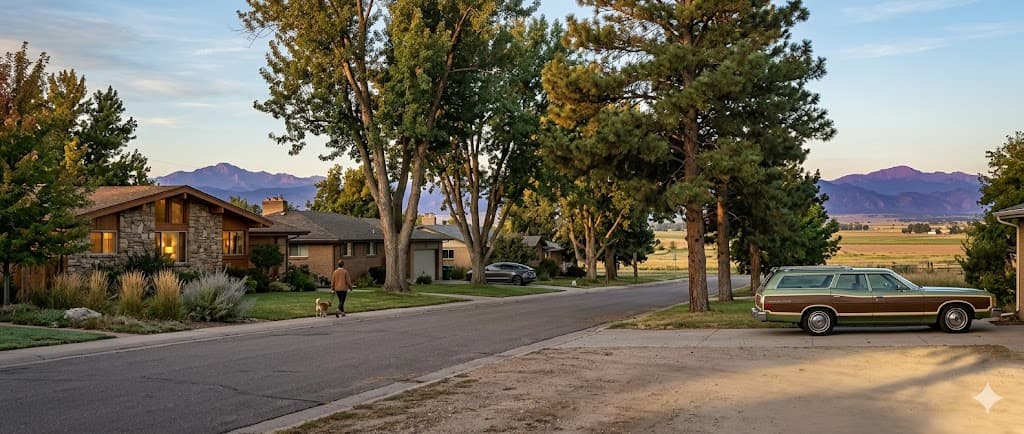
Home Equity in Greeley — HELOC and Home Equity Loans From a Local Lender
Northern Colorado's value town has spent decades doing what value towns do: owners bought sensibly, paid down steadily, and let the region's growth do the rest. The result is real equity in ordinary houses — and this page is the plain-spoken guide to reaching it.

See Your Maximum HELOC
Slide to your home’s current value for an instant estimate.
Maximum HELOC Available
$357,000
Based on 85% CLTV · Program maximum: $750,000
Want your real number? Subtract your existing mortgage balance from this — or let our full calculator do it for you.
No credit impact · 60-second full estimate
Three Ways to Reach Your Equity
You searched for a Greeley HELOC; here's the whole menu, no runaround. Three ways to borrow against a home you own — two of them leave your current mortgage completely alone, and the third replaces it, which is exactly why it comes last.
HELOC
Open it once, use it as needed
Revolving credit against the house
Fixed- or variable-rate programs, sized at opening and there when the roof, the remodel, or the opportunity actually arrives — the practical choice for most Greeley plans.
Home Equity Loan
The full amount, day one
One payout on a fixed schedule
Best when the bill is already known — a contractor's quote, a consolidation total — funded in full and repaid on a schedule that never surprises you.
Cash-Out Refinance
Last resort, said plainly
Your old mortgage goes away
It swaps your existing first mortgage for a new, larger one at today's pricing. If you locked your loan in a better market, run the other two options first.
A Hundred and Fifty Years of Sensible Ownership
Market Snapshot
Greeley, CO
- County
- Weld County
Greeley has been building housing since 1870, when it was planned as the Union Colony — and the ledger shows every era: designated historic blocks of Foursquares and Craftsman bungalows between downtown and the university, the postwar and seventies-to-eighties family neighborhoods around the parks, the nineties-to-2000s subdivisions, and now a construction corridor racing west toward Windsor. The equity concentrates where the tenure is: owners in the established grid who bought at Greeley prices — while the towns next door climbed out of reach — and quietly paid principal for years. When neighboring-county buyers chase value here, they confirm what current owners already banked.
Two Weld County facts sweeten the math. The county runs debt-free, charges no county sales tax, and holds one of the lowest county property-tax levies in Colorado — the oil patch carries the load — so the county's own line on a Greeley tax bill is one of the lightest in Colorado. The caveat lives on the west side: the newest subdivisions are financed through metropolitan districts whose levies stack on top, a post-2018, new-development phenomenon that the older grid mostly never adopted. Same city, two tax realities — the file simply reads which one is yours. And when title work notes severed minerals or a nearby well, that's routine Weld paperwork, not a problem: it's handled inside the process every local file goes through.
An Owner's Town, Which Is the Whole Point
For all its college-town energy, Greeley is a place where owner-occupants hold the majority of the housing — a stronger owners' share than its famous neighbor to the northwest — and primary residences get the longest menu in equity lending: more willing lenders, a deeper cut of the home's value, thinner paperwork. If your home is near the university where rentals cluster, occupancy is simply the first thing to state, because it sets the program. And one candid boundary, offered up front because it saves people time: manufactured homes on leased land generally sit outside standard home-equity products — if that's your situation, say so early and I'll tell you truthfully what exists.

Greeley owners might be the best-positioned borrowers in northern Colorado, and the least likely to brag about it: bought sensible, paid down, taxes kept light by the county. So let me ask the question the spreadsheet can't: the remodel you keep pricing, the rental you almost bought twice — if the line were already open, which one happens this year?
— Bobby Friel, NMLS# 332039
How It Works With One Local Lender
Say what you own and what you're after
Address, occupancy, and the plan — with the county's most recent valuation notice in hand if you have it, because that's a fine place to start the equity math.
Get the value confirmed
A proper valuation for your block and era — an updated 1910s bungalow, an eighties tri-level, and a brand-new west-side build are three different appraisals.
Pick the structure and place the file
Fixed or variable, revolving or single payout — on a soft pull through prequalification, with the one hard pull only at full application.
Close and put it to work
A complete file can fund in as few as 5 days — roof season, remodel season, or whenever Greeley's weather decides for you.
The Mistakes Greeley Owners Make
Mistake 01
Meeting the hail adjuster before the lender
This is hail country, and modern policies commonly carry percentage wind-and-hail deductibles — which means a roof claim can leave a five-figure gap between the check and the actual roof. Owners who open a line before storm season bridge that gap on their own terms; owners who start the paperwork afterward wait in line with the whole ZIP code. And a new impact-rated roof pays twice: it closes the claim and improves the home's appraised condition.
Mistake 02
Reading one Greeley tax bill and assuming yours matches
An older-grid home and a new west-side build pay into two different ledgers — the district levies on new subdivisions stack well past the county's unusually light base. Neither is wrong; the affordability math for your loan simply uses yours, not your cousin's across town.
Mistake 03
Guessing at eligibility instead of asking
A house near campus that you actually live in? State the occupancy and proceed. A designated historic home? Borrow freely — just check renovation scope with the city's preservation office before the contractor drafts plans. A manufactured home on leased land? Usually outside standard equity products, and you deserve that answer at the start, not mid-file.
Your Greeley Equity Questions, Answered
Plain Question. Plain Answer. Funded.
Ten minutes on the phone gets you the straight version: your number, your program, and what happens next — no obligation, and your current mortgage never moves.