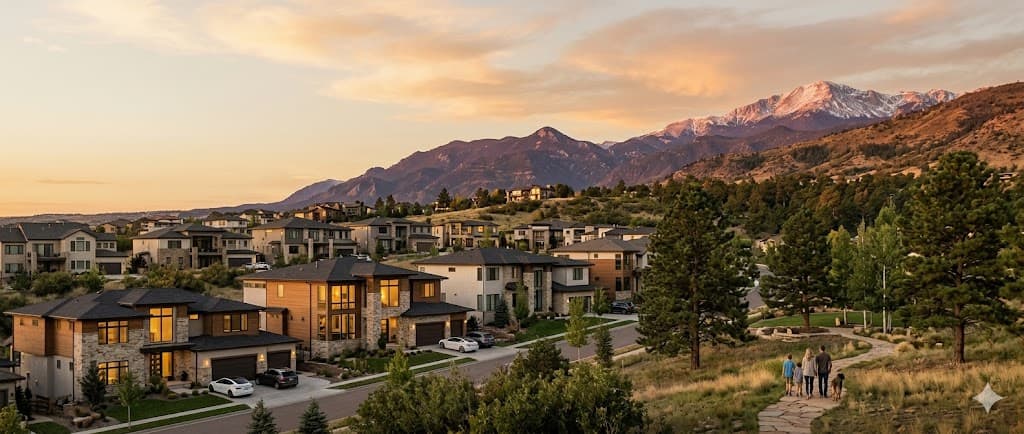
Highlands Ranch has never had a retirement generation before. It has one now.
That sentence sounds unremarkable until you sit with what this place is: a master-planned community that broke ground in the early 1980s, which means that for its entire existence it has been a suburb of arrivals — young families, school-age kids, moving trucks. The people who bought Northridge's first houses in 1987 were in their thirties. They are not in their thirties anymore. For the first time in its history, the Ranch's founding cohort is aging in place at scale, and an entire community designed around growth is learning what it looks like when its original owners simply stay — mortgage-free, equity-rich, and uninterested in leaving the place they watched get built.
I find the equity math here more compelling than almost anywhere on the Front Range, because it happened inside living memory and inside one address. A Northridge original who bought in the late eighties has watched four decades of appreciation accumulate on a house that long ago stopped costing a mortgage payment. The wealth is real, it is large, and it is almost entirely illiquid — which is precisely the situation reverse mortgages exist to address, and precisely the population the founding Ridges now hold in numbers.
The program map follows the construction map. The four Ridges — Northridge, Westridge, Eastridge, Southridge — along with Firelight and The Hearth, hold typical values inside the standard federal program's range, so the government-insured HECM at 62 is the workhorse product across nearly all of the community, and I verified that against current sales data rather than assuming it. BackCountry, the gated custom section against the wilderness area, is the closest thing to an exception — but even there, the data says some homes clear the standard program's coverage and most don't, so the answer runs house by house, not by gate code. For an owner facing an early-retirement offer at 57 whose specific BackCountry home qualifies, the jumbo proprietary programs open at 55 — options the FHA-insured HECM's 62 wouldn't give them yet. Everywhere else in the Ranch, the years before the standard HECM's 62 usually mean getting ready, not finding a workaround.
Structure matters unusually much here, for a demographic reason: Ranch couples of the founding generation frequently span the standard HECM's 62 threshold — one spouse eligible, one not yet. The old version of this industry hurt people in exactly that gap, and the reformed version protects them, but only when the protection is built at application. The non-borrowing-spouse conversation is the first one I have with any couple here, before products, before numbers. It is the difference between a tool and a trap, and it is entirely controllable in advance.
The exclusions are the usual ones, with a Ranch-specific accent. Anyone planning to follow the grandkids out of state within a couple of years should skip this product; the costs want a long stay. Anyone whose need is genuinely small has cheaper tools. And the community's own costs continue regardless — HRCA dues, Douglas County taxes, insurance that's repricing against hail and the wildfire interface at the southern edge. A reverse mortgage removes the payment; it does not remove the obligations of staying, and pretending otherwise is how this product earned the old reputation it's still living down.
I serve Colorado statewide from my base in Edwards, and Highlands Ranch is where I watch the next chapter of a familiar story get written — a community that has always measured itself by growth discovering that its founding families became its wealth, quietly, one staying-put decade at a time. The suburb they built is worth more than anyone projected. The question worth asking, in whichever Ridge someone happens to be asking it: whether it's time some of that value started coming back to the people who spent decades building it.