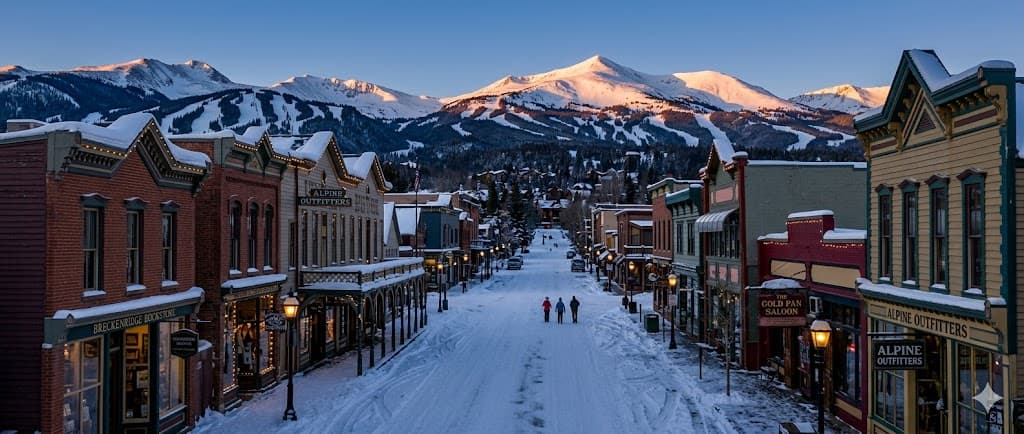
There's a paper lift ticket in a desk drawer near Main Street, dated 1978, the wire wicket still bent the way it came off the jacket zipper. The man who keeps it held it up to his camera on our first video call, by way of explaining when he and his wife bought their Victorian — the winter that ticket was new, when a drafty miner's cottage in Breckenridge was a working family's reach, not a portfolio line. He didn't keep the ticket to be sentimental. He kept it, he says, because nobody believes what the town cost until you show them something with a date on it.
That ticket is the right frame for reverse mortgages in Breckenridge, because everything difficult and everything promising about this market is the distance between 1978 and now. The couple who bought then are in their seventies today, sitting on appreciation no spreadsheet predicted, in a town where most of the surrounding doors now belong to second-home owners and short-term rental guests. And that surrounding fact matters more here than anywhere on the Front Range: a reverse mortgage — standard or jumbo — requires the home to be the borrower's primary residence. In a town where roughly two-thirds of the housing isn't anyone's primary residence, this page is written for the year-round minority who actually hold the keys it applies to.
For that minority, the program map is unusually interesting, and I verified it against current data rather than the town's reputation. Shock Hill, the Highlands at Breckenridge, and Timber Trail clear the federal lending limit as the norm — three of the only defensible jumbo calls in this entire region of the state, each one backed by a named, dated source. The Historic District, Warriors Mark, and Peak 7 are genuinely mixed: detached homes frequently clear the limit, the condo majority sits well under it, and the fractional stock at the base areas generally can't hold a reverse mortgage at all. Citywide, the typical value lands just below the federal ceiling — which is the statistical way of saying the address decides everything here.
The age rules reward precision, and I hold an NMLS license, so precision is what you'll get: the standard HECM requires 62, federally, without exception. The jumbo proprietary programs through my lending network open at 55, for homes valued past the standard ceiling. In Breckenridge that combination is not theoretical — a 57-year-old with a primary residence above the gondola may have options a Front Range homeowner the same age simply doesn't. The reverse is equally true: a 57-year-old in a base-area condo likely waits for the standard HECM at 62, and deserves to hear that plainly instead of after a month of doomed paperwork.
Condo owners carry one more gate worth naming early: a standard HECM requires the building itself to survive FHA review, and resort buildings with heavy rental mixes or fractional structures often don't. I check the building before anything else, because the alternative — discovering it in underwriting — costs a season.
The rest of the discipline is ordinary and unglamorous. Insurance is a condition of the loan, and mountain carriers are re-tiering wildfire and building risk every renewal. Taxes follow the county's valuation of the neighbors' exuberance. Maintenance at this altitude runs on an accelerated clock. A reverse mortgage removes the mortgage payment; it does not remove the cost of owning a home at nine thousand six hundred feet, and any plan that pretends otherwise isn't a plan.
I serve Colorado statewide from my base in Edwards, and Breckenridge is one of the markets where that model earns its keep: the first step is a video call, the documents move electronically, and the transaction gets run right regardless of which side of Vail Pass anyone sleeps on. Bring the skepticism. Bring the lift ticket, if you kept one. The appraisal and the data will do the rest of the talking.