"I don't need the money. I just don't want to need it and not have it." That's how a Boulder homeowner in her late sixties put it to me, sitting at her kitchen table in Table Mesa, a house she and her husband bought in 1979 and never left.
She wasn't in financial trouble. Her mortgage was nearly paid off, her retirement accounts were reasonable, and she wasn't planning any large purchase. What she wanted was a resource that existed before she needed it — something available if a repair, a health cost, or a slow year showed up later, without having to qualify for anything new a decade from now instead of today. That's a genuinely different conversation than the one most people expect when they hear "reverse mortgage," and it's one I have with Boulder homeowners more often than almost anywhere else in Colorado.
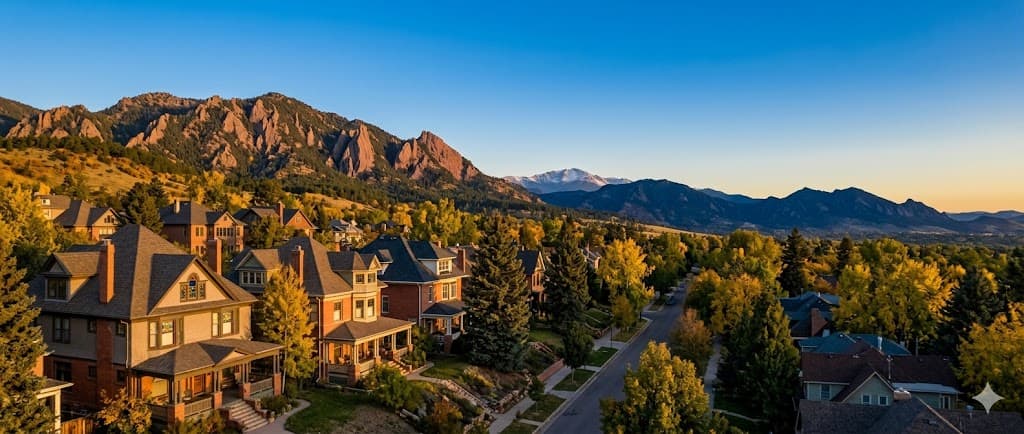
Boulder's neighborhoods make that conversation vary a lot depending on where someone lives. Mapleton Hill and Newlands, with their century-old housing stock and long-tenure ownership, have appreciated into a range where the standard federal reverse mortgage limit doesn't cover most of the home's value — that's jumbo proprietary territory. Wonderland Hills, built out in the early 1970s and still full of original-era owners, is much the same story. Martin Acres and Frasier Meadows, by contrast, remain solidly within the standard HECM's reach — same city, same demographic, different numbers.
I hold an NMLS license, which means I have to be exact about a detail that gets blurred constantly in reverse mortgage marketing: the standard, government-insured HECM requires age 62. The jumbo proprietary programs, run through my lending network rather than FHA, allow qualified borrowers as young as 55. Which one applies to a given Boulder homeowner depends on their age and their home's value — not on anything else.
Not every homeowner who calls me ends up needing either one. Someone with a smaller mortgage balance and years of working life still ahead usually has better tools available. Someone planning to sell and downsize within the next year or two is better served by that conversation instead. I've told Boulder homeowners directly that a reverse mortgage wasn't the right move for them, because the alternative — letting the size of a Boulder home's equity do the persuading — isn't the kind of business I want to run.
The homeowner from Table Mesa ended up opening a standby line of credit rather than taking a lump sum. She hasn't touched it. It grows the longer it sits there, and it'll be worth more by the time she actually needs it than if she'd taken the same amount as cash today. That's usually the better structure for someone who, like her, doesn't need the money yet — just the certainty that it's there.
The other conversation I have often in Boulder is the one with adult children, some of whom still live locally, some of whom don't. A reverse mortgage discussed openly, with the family looped in early, tends to land as a smart use of a resource the family already has. Handled quietly and revealed after the fact, it tends to land as something else entirely, even when the numbers were identical.
I serve Colorado statewide from my base in Edwards, and Boulder is a market where the answer genuinely depends on the address — jumbo in some neighborhoods, standard HECM in others, sometimes neither. I'd rather find out which one actually fits your home than assume.